
Epoxy vs Tile Garage Floor: Which One Should You Choose?
For a garage you park in through a Pennsylvania winter, we would pick an epoxy coating on bare, ground concrete. Interlocking tiles cost less and go down without a pro. Ceramic and porcelain tile cost the most to install.
HomeGuide’s national cost guides put garage floor coatings at $4 to $12 per square foot installed. An epoxy floor for a two-car garage runs $1,600 to $5,800. Snap-together tiles you lay yourself run $2 to $5 per square foot, or $800 to $2,900 for the same garage.
Ceramic tile runs $12 to $40 per square foot installed, and porcelain runs $15 to $50. These are market numbers, not our price list. If you want one seamless surface you can squeegee after a snowstorm, garage floor epoxy is built for that job.
What is the difference between epoxy and tile on a garage floor?
An epoxy coating bonds to the concrete itself. It goes on as a liquid and cures into one hard surface with no seams. HomeGuide lists a seamless finish and chemical resistance among the strengths of a coating. The same guide lists the downsides: it needs a professional installer, and the install takes longer.
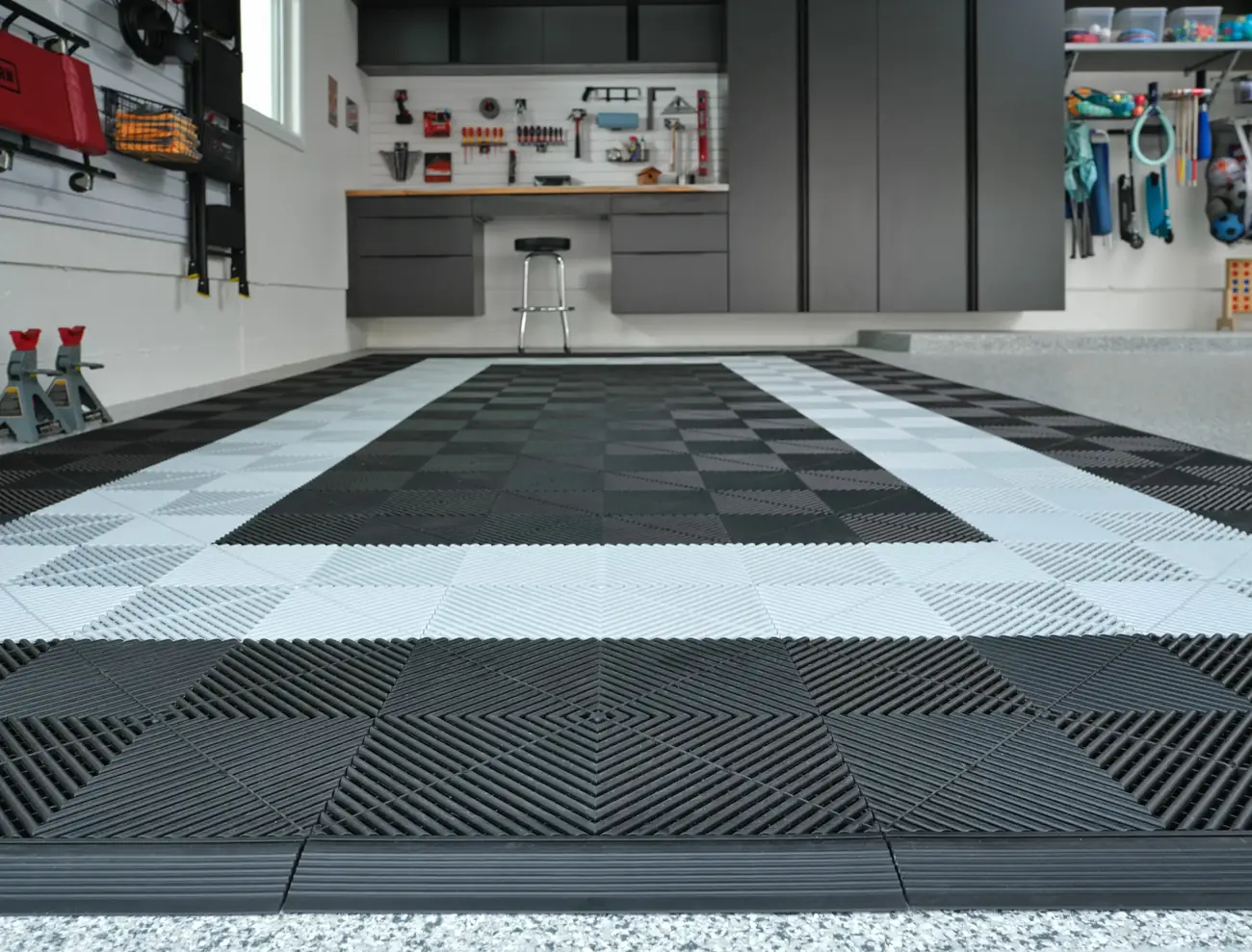
People mean two different floors when they search for garage tile. Interlocking garage tiles are snap-together squares that sit loose on top of the slab. Ceramic and porcelain tile are set in thinset mortar with grout joints, like a kitchen floor. Each one trades against epoxy in its own way.
How do interlocking garage tiles compare to epoxy?
Interlocking tiles are the do-it-yourself choice. HomeGuide counts easy DIY installation and custom patterns among their pluses. The floor can also come back up and go with you when you move. Nothing has to cure, so the car can go back in once the last tile clicks into place.
The drawbacks sit underneath. HomeGuide says garage tiles may trap moisture and are not as durable as some coatings. In a Central Pennsylvania winter, snowmelt and road salt drip off every car that pulls in. Water that works down between the squares can sit on the slab where you never see it.
A coated floor keeps that mess on top. Salty slush stays on the surface, where a squeegee or a mop can reach it. That is the main reason we lean toward a coating for a garage that sees winter driving.
How do ceramic and porcelain tile compare to epoxy?
Ceramic and porcelain are the premium tile choices, and the price shows it. Both start at or above the top of HomeGuide’s range for garage floor coatings.
Of the two, porcelain is the tougher tile. HomeGuide notes it is fired at higher temperatures and is less porous than ceramic. Its porcelain guide calls porcelain denser and more water-resistant. It says ceramic is less resistant to chipping and moisture.
The weak spot in both is the grout. A tile floor is a grid of joints. Every joint is a seam where oil and salty water can settle. An epoxy floor has no joints to scrub.
Can you put epoxy over tile?
It can be done, and some installers do it. SF Huling takes a different route: we take the tile and the thinset up and grind the slab. Then we coat bare concrete.
Sherwin-Williams, a major coatings maker, explains why in a technical article for flooring contractors. It calls coating over a ceramic tile and grout floor challenging. It describes ceramic tile as typically glazed and often very slick. A slick glaze leaves a coating little to grip. The glaze has to be ground off first, and the article warns that this can crack tiles or pop them out.
The article adds that many flooring contractors find full removal of the tile at the outset more efficient and economical. It also says a resin floor is only as good as the concrete underneath. A coating laid over tile depends on every tile staying stuck to its thinset. If one tile lets go, the coating over it goes too.
That is why tile removal and concrete grinding and floor prep come before any coating we put down. Interlocking tiles are simpler, since they lift right off. The slab that sat under them gets ground and checked for moisture first.
HomeGuide notes that pros may need to run moisture tests before a new coating. Its epoxy guide adds that epoxy cannot bond properly when wet.
Old 9 by 9 inch floor tile in an older home is a separate case. New Jersey’s health department lists vinyl floor tiles, usually 9 by 9 inches, among household products made with asbestos. Tile like that gets tested before anyone breaks it up. Our guide to asbestos floor tile removal in Pennsylvania covers the steps.
What does each garage floor cost?
These are market numbers from HomeGuide’s 2026 cost guides, not our price list. Your own floor prices off its size and condition, plus anything that has to come up first.
| Floor option | Published cost per square foot | Two-car garage total |
|---|---|---|
| Epoxy coating, installed | $4 to $10 | $1,600 to $5,800 |
| Garage floor coatings overall, installed | $4 to $12 | $1,600 to $6,900 |
| Interlocking garage tiles, DIY | $2 to $5 | $800 to $2,900 |
| Ceramic tile, installed | $12 to $40 | not given |
| Porcelain tile, installed | $15 to $50 | not given |
| Removing existing tile | $2 to $7 | not given |
If tile is already down and you want epoxy, the removal line gets added to the coating. HomeGuide gives epoxy a life of 3 to 20 years and up to a week to cure. Interlocking tiles skip the cure time.
Which garage floor is right for you?
Interlocking tiles make sense if you rent or want a weekend project you can take with you. Porcelain fits a show garage where the budget is open and you want the look of tile.
For a working garage with a car in it every winter night, we would coat the concrete. If you like tile for its patterns, a flake epoxy flooring system broadcasts colored flakes into the coating. You get a pattern across one continuous surface.
Where does SF Huling fit in?
SF Huling is based in Lock Haven and backed by 30 years of commercial flooring experience. We coat garages across Central Pennsylvania. The same company that pulls up old tile grinds the slab and puts the coating down.
Estimates are free. Call or text (570) 772-2721, or read how we coat a garage floor.