Epoxy vs Polyaspartic Floor Coatings: Which One Is Better?
Neither one wins across the board. Polyaspartic cures in hours and holds its color in sunlight. Epoxy builds a thicker film, handles damp slabs better, and costs less per square foot. Most coating failures trace back to the same thing: concrete that was never ground.
Here are the market numbers first. National 2026 cost guides put professionally installed epoxy at roughly $3 to $8 per square foot. The same guides put polyaspartic at roughly $6 to $12. These are market numbers, not our price list. SF Huling installs epoxy floor coatings in Lock Haven and across Central Pennsylvania, and estimates are free.
What is an epoxy floor coating?
Epoxy is a two-part coating. A resin and a hardener get mixed, and the reaction turns them into a hard plastic film. A professional epoxy is 100 percent solids, so almost nothing evaporates. The film that goes down is the film you keep.
That thickness is epoxy’s strength. Coating manufacturers report adhesion pull tests in the 400 to 500 PSI range on properly prepped concrete. Epoxy also soaks into open concrete pores and locks in. Vapor-barrier epoxies are built for wet slabs. One concrete trade site reports epoxy that resists moisture vapor emission as high as 18 pounds.
The catch is time and temperature. Epoxy cures slowly, and it gets fussy when the slab is cold.
What is a polyaspartic coating?
Polyaspartic is a type of polyurea. It uses an aliphatic hardener, and that is the part that makes it UV stable. Coating manufacturers describe polyaspartics as materials that will not yellow or break down in sunlight.
Polyaspartic goes on thinner per coat than epoxy and cures much faster. It also stands up well to abrasion and chemicals. It costs more per gallon, and it gives the installer a much shorter window to work in.
How fast does each one cure?
This is the biggest practical gap between the two.
A concrete trade publication puts polyaspartic cure times at under 10 minutes to 45 minutes. Solids content, slab temperature and the product itself all move that number. Cost guides list light foot traffic in 2 to 4 hours and full cure inside about a day. That is where the one-day garage floor comes from.
Epoxy runs on days. The same trade publication describes epoxy and polyurethane systems as 4 or 5 day installs. A coatings manufacturer’s cold-weather bulletin gives a useful rule. For every 18 degrees below 70 F, epoxy cure time doubles. An 8 hour cure at 70 F becomes about 18 hours at 50 F.
Fast has a cost. That same trade publication flags the risk plainly. If polyaspartic sets before the installer finishes, the floor keeps trapped bubbles, blisters and lap lines. A coatings professional quoted there prefers the slower epoxy and polyurethane route. That source calls it less temperamental and a better quality floor.
Does epoxy really turn yellow in sunlight?
Standard epoxy ambers under UV light. Technical sources trace the color shift to carbonyl groups forming at the surface. The change is permanent until the floor is sanded and recoated. Polyaspartic does not do this.
How much that matters depends on your floor. Sun through garage door windows will find a bare epoxy. So will an overhead door open all summer, or a glass storefront. A basement, a closed shop or a warehouse interior will not.
The market’s usual answer is a durable clear topcoat over the epoxy. The topcoat takes the sun and the traffic, and the epoxy underneath does the bonding.
What temperature can each coating go down in?
Epoxy wants warmth. A coatings manufacturer states epoxy is best applied above 50 F. Most epoxies never fully cure below that unless they are built for cold weather. Other trade guidance puts the practical floor at 55 F to 60 F slab temperature. Cold epoxy also thickens, mixes poorly and leaves bubbles and uneven spots.
Polyaspartic has a wider window. Product data sheets commonly list substrate ranges of about 20 F to 120 F. Most call 50 F to 90 F the sweet spot. Some low-temperature polyaspartics are rated down to 30 F, and one is listed as low as minus 20 F.
In Central Pennsylvania that gap is real. An unheated garage in Lock Haven or State College sits well under 50 F from December into March. Either chemistry needs the slab warmed, or the work put off for a warmer stretch.
What does each one cost?
Everything below is a published market range. None of it is our pricing.
| Coating system | Published range per square foot, installed |
|---|---|
| Solid color epoxy | $3 to $7 |
| Full broadcast flake epoxy | $4 to $8 |
| Polyaspartic systems | $6 to $12 |
| Metallic epoxy | $7 to $15 |
Those ranges come from 2026 national cost guides. A national cost calculator ran higher, at $7.78 to $12.71 per square foot. Its reference job was only 129 square feet. Small floors always price higher per foot.
Pennsylvania-published figures land in the same place. A Pittsburgh contractor’s 2026 price guide lists solid color epoxy at $3 to $7 per square foot. Full flake with a polyaspartic topcoat runs $5 to $12 there, and metallic $9 to $20. That guide puts a 450 square foot two-car garage between about $1,350 and $5,400. A national home services cost site lists a Philadelphia epoxy flooring average of $2,561. Most jobs there fall from $1,780 to $3,382.
Which one lasts longer?
You will see polyaspartic quoted at 15 to 25 years and epoxy at 5 to 10. Read those numbers with care. Most of them are published by companies that sell polyaspartic.
What both chemistries share is the failure mode. A coating lets go at the bond line, and rarely in the middle of the film. That puts the lifespan question back on the prep.
Why does prep matter more than the chemistry?
A coating only holds if the concrete is opened up first. The industry measures that with the ICRI concrete surface profile scale, which runs from CSP 1 to CSP 9. Hitting a real profile takes diamond grinding the slab.
Acid etching is the shortcut that costs people their floors. It roughens the surface a little, leaves salts behind that fight adhesion, and cannot touch an existing sealer. Grinding pulls off laitance, old coatings and adhesive, and cuts a profile the coating can bite into.
Film thickness is the other half. Big-box kits are usually water-based and cure to about 3 to 5 mils, close to a coat of paint. Professional 100 percent solids systems go down many times thicker. Thin coating on a smooth slab is how hot tire pickup starts. Warm tires soften the film and peel it up.
What does SF Huling install?
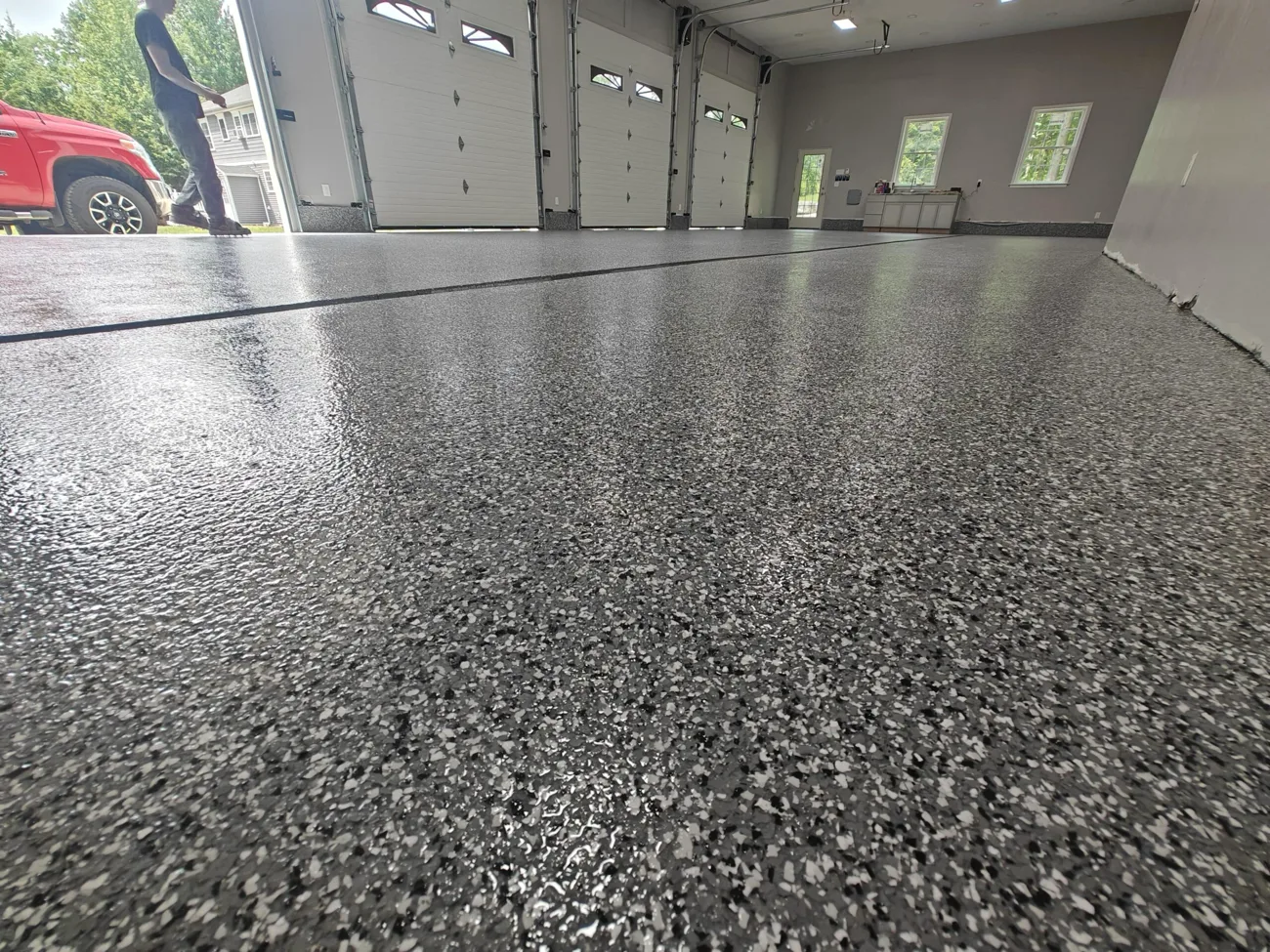
We install epoxy floor coating systems with a durable clear topcoat. That means full broadcast flake and metallic finishes on garage floors, basement slabs, and commercial and industrial floors. Polyaspartic is a good product, and plenty of shops build good floors with it. Our lane is epoxy.
The same company tears out your old floor and grinds the slab before any coating goes down. The company is backed by about 30 years of commercial flooring experience. We are based in Lock Haven and work the State College and Williamsport corridor.
Estimates are free. Call or text (570) 772-2721 and we will look at your floor and tell you what it needs.