
What Does Flooring Removal Cost in Pennsylvania?
Published market ranges put flooring removal at roughly $1 to $7 per square foot. Carpet sits at the bottom of that band. Ceramic and porcelain tile sits at the top, because the mortar under it has to come off too.
The material is only half the answer. What the old floor is stuck to decides the rest. A floating laminate plank lifts in minutes. A vinyl tile glued to a 1960s slab fights back for hours. These are market numbers, not our price list.
What do national cost guides say flooring removal costs?
Below are 2026 figures from national cost guides, per square foot, with labor and haul away included.
| Old floor | Published removal range per sq ft | What drives the number |
|---|---|---|
| Carpet and pad | $1.00 to $2.50 | Tack strips, staples, glue lines, bulk to haul |
| Floating laminate | $2.00 to $3.00 | Fast to lift, underlayment comes up with it |
| Vinyl plank or sheet vinyl | $1.00 to $4.00 | Floating is quick, glued is slow |
| Glued down vinyl and VCT | $2.50 to $4.00 | Scraping old cutback adhesive off the slab |
| Hardwood nailed to a subfloor | $2.00 to $3.00 | Prying boards, pulling nails and staples |
| Hardwood glued to concrete | $3.00 to $4.50 | Adhesive left welded to the slab |
| Ceramic or porcelain tile | $3.05 to $5.64 | Chipping each tile off its mortar bed |
| Thinset or mortar left behind | Add $2.33 to $4.44 | Grinding the slab back to clean and flat |
Homewyse, a national cost calculator, listed general flooring removal at $2.42 to $4.47 per square foot in May 2026. Its tile line ran $3.05 to $5.64. Its carpet line ran $1.37 to $2.49.
Angi, a national home services marketplace, lists a wider band of $1.50 to $3.50 for removing old flooring. Its tile figure runs $2 to $7. That marketplace’s Philadelphia page budgets $1.50 to $6 per square foot for Pennsylvania homeowners. Priced on its own, that work is floor demolition and tear out.
Why does tile cost the most to remove?
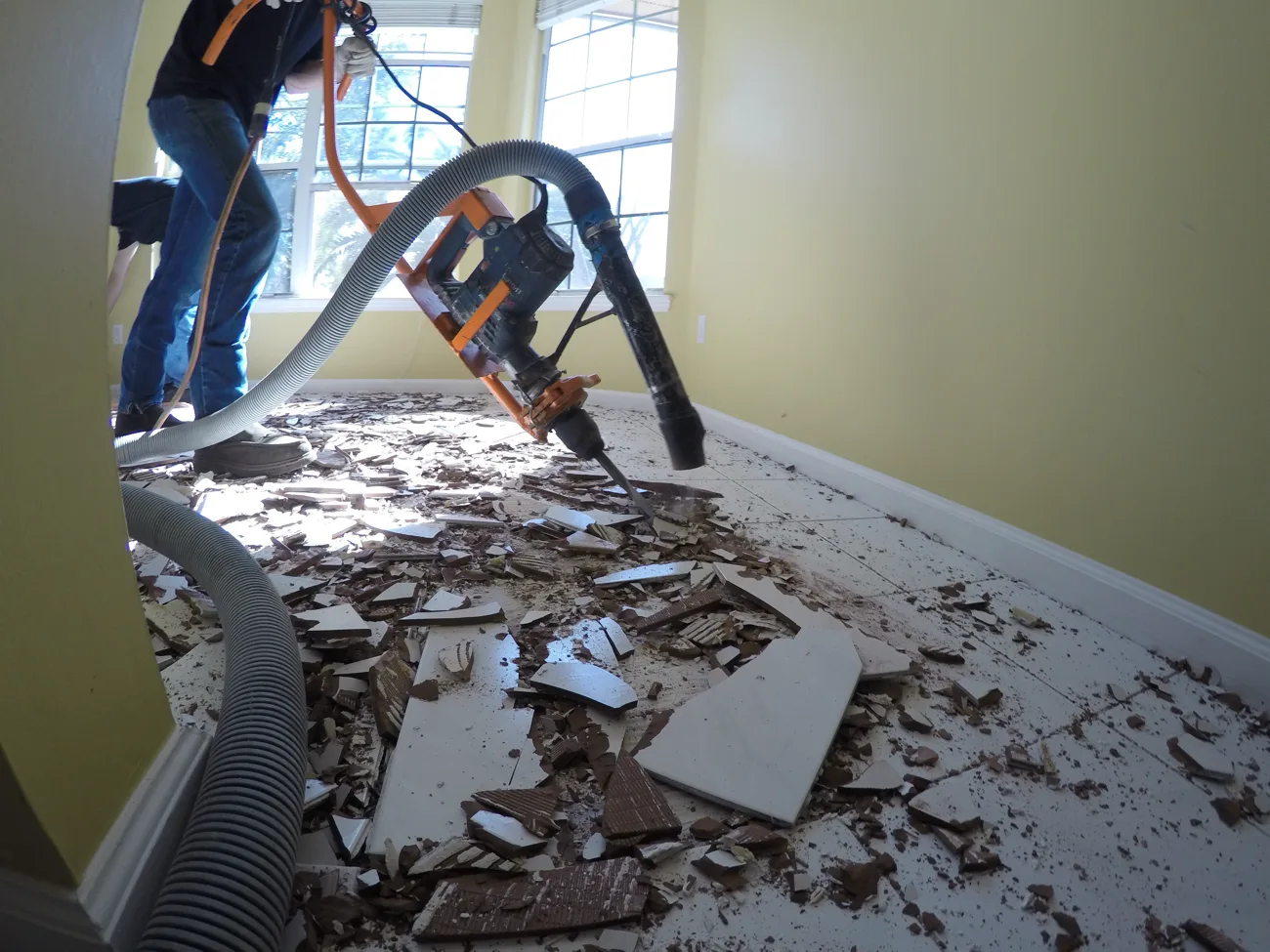
Tile is two jobs stacked on each other. The tile gets chipped off first. Then the thinset or mortar bed under it has to come off the slab.
National guides price that second half separately. Homewyse listed mortar removal at $2.33 to $4.44 per square foot on top of the tile. Guides also note that porcelain and natural stone grip harder than plain ceramic, so they run higher.
Dust control is the other line. Cost guides put dust controlled tile removal, done with vacuum shrouded tools, near $3.50 to $7 per square foot. The rate is higher and the rest of the house stays usable.
What makes a Pennsylvania floor harder to tear out?
Age. The Pennsylvania Association of Realtors reported a statewide median construction year of 1964. It put the median age of a Pennsylvania home at 57 years. Only three states have older housing.
Old houses mean layered floors. Sheet vinyl over vinyl tile over a plank subfloor is a normal find here. Every layer adds labor, and labor is most of what you are buying.
Old glue raises the number again. Adhesive that cured for forty years scrapes far slower than a recent install. Cost guides put that penalty near 30 to 50 percent on heavy mastic.
Should an old floor be tested before it comes up?
Yes, if it dates to the 1970s or earlier. Nine inch by nine inch vinyl tile often contained asbestos. So did the black cutback mastic under it, into about 1980. Older Central Pennsylvania basements and kitchens are a common place to find both.
Testing is its own line item. National guides put an asbestos test near $230 to $780. A positive result sends the floor to an abatement contractor. Published removal rates then jump to $5 to $15 per square foot.
If a floor looks like a candidate, we say so, and testing comes first. A lab result costs far less than a bad tear out.
What else lands on a flooring removal quote?
Disposal. Old flooring is heavy and bulky. Cost guides list haul and dump fees at $0.45 to $0.60 per square foot. A rented dumpster runs $200 to $800 per week.
Access. Stairs, tight doorways and a long carry to the truck all add time. A second floor bedroom costs more to clear than a walkout basement.
Room size. Small rooms price higher per square foot because setup and cleanup do not shrink. Most guides show a minimum charge around two hours of labor.
Subfloor condition. Guides add $1 to $2 per square foot when the deck under the old floor needs repair. Nobody can price that up front, because the damage only shows after the tear out.
Does a commercial tear out price the same as a house?
The published guides above are written for homeowners. Commercial work moves on the same cost drivers, with different weights.
Square footage helps you. A wide open retail floor or shop bay carries less setup per foot than a 90 square foot bathroom. Big continuous areas usually land at the low end of a published range.
Access works the other way. Loading docks, elevators, tight hallways and scheduling around an open business all add hours. Glued down VCT and glued carpet tile are the common commercial finds, and both are adhesive jobs.
Does the slab need grinding once the old floor is gone?
It depends on what goes down next. Carpet and laminate can sit on a rough slab. An epoxy floor coating needs a better surface than that.
For a coating, the slab has to be clean and opened up so the new material bonds. That step is concrete grinding and floor prep, and it is priced separately. Removal pricing covers light adhesive scraping. Full mechanical prep is its own work.
If new tile or carpet is going down instead, another trade installs it. We remove floors and prep slabs. We do not install new tile, carpet, wood or vinyl.
How do you get a real number for your floor?
Ranges get you close. A look at the floor gets you the number. Square footage, the material and what is glued underneath set the price. So does the way debris leaves the building.
We are based in Lock Haven and cover the State College and Williamsport corridor. Estimates are free. Call or text (570) 772-2721, or read how a tear out job runs start to finish.