
Garage Floor Paint vs Epoxy: Which One Actually Lasts?
A professional epoxy coating lasts. Garage floor paint does not. Two things decide it: how thick the film is, and how the slab was prepped.
The published data sheets make the gap easy to see. Rust-Oleum lists its water-based EpoxyShield garage kit at 3.0 to 3.5 dry mils per coat. One coat is usually all you get. A flooring manufacturer’s spec for a single-broadcast flake system puts that system at a nominal 30 mils. That is roughly ten times the film over the same square foot of concrete. If you park a car in the garage all winter, garage floor epoxy is the option built for it.
What is the real difference between garage floor paint and epoxy?
Garage floor paint is a one-part product. You open the can, roll it out, and the water or solvent leaves as it dries. What stays behind is a thin colored film sitting on the surface.
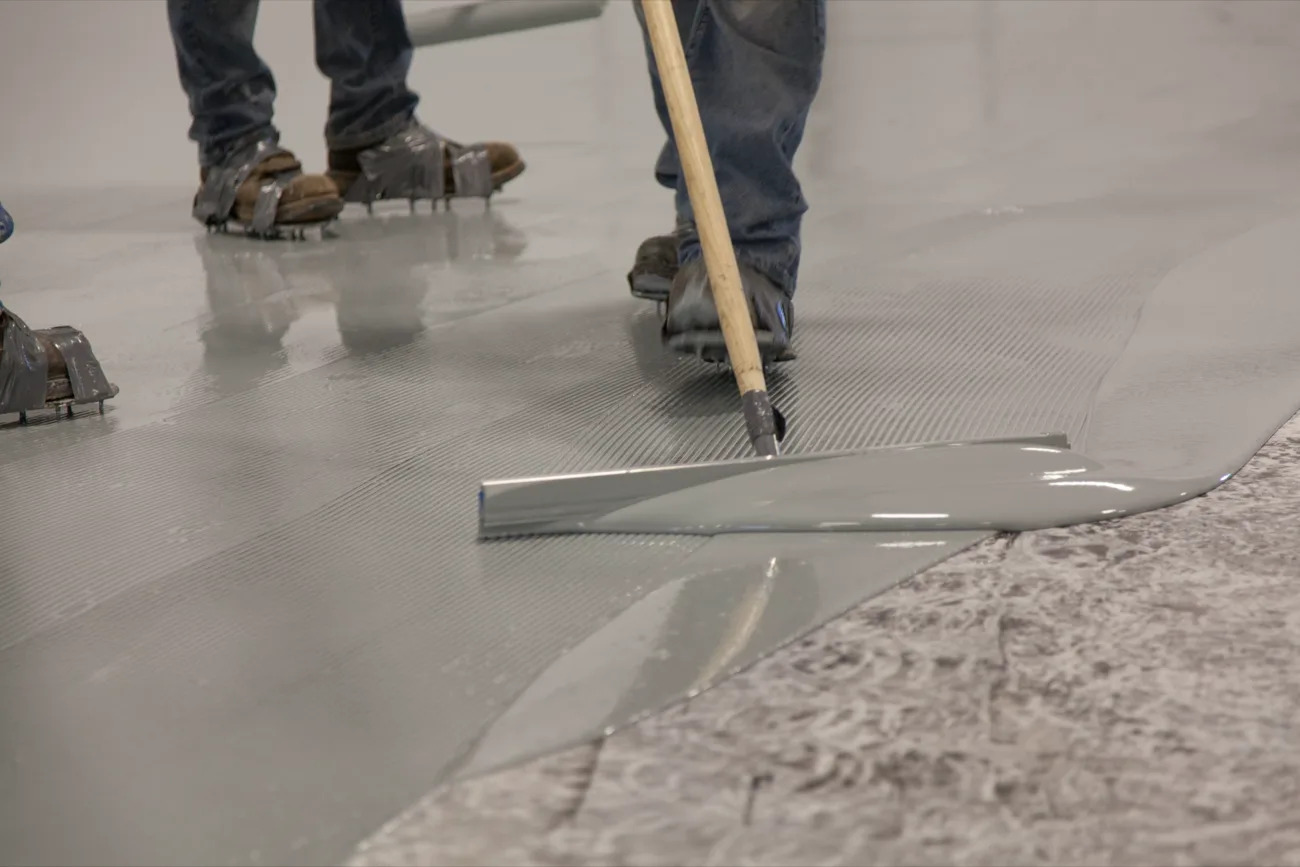
Epoxy is two parts. A resin and a hardener mix, react, and cure into a hard plastic that keys into the concrete. A full garage system stacks a base coat, a flake broadcast and a clear topcoat on top of that.
Thickness is the number that settles the argument. Behr lists a spread rate of 300 to 400 square feet per gallon on rough concrete. That figure comes from the data sheet for its one-part garage coating. Stretch a gallon that far and the dry film lands in the low single-digit mils. A full broadcast flake system is built in layers and measured in tens of mils.
Why does garage floor paint peel in the tire tracks?
The failure has a name. Euclid Chemical’s technical bulletin on tire marking calls it plasticizer migration. Tire rubber carries plasticizers that keep it soft. Driving heats the tire, the plasticizers soften, and they leach out onto whatever the tire parks on.
Then the warm tire grips the coating as it cools. If the film is thin and the bond to the slab is weak, the tire wins that contest. The coating lifts in the shape of the tread. Pieces of it back out of the garage on the tire.
The same bulletin notes that epoxy and urethane coatings are far more crosslinked than acrylic sealers. That structure is why they resist marking better. Paint has little of it. Behr’s own sheet says an annual touch-up may be required in areas subject to tire traffic. That is the maker of the product telling you what to plan for.
Do DIY epoxy kits hold up better than paint?
They are a step up, and they are still thin. The Rust-Oleum kit runs 52.6 to 52.8 percent solids by volume. About half of what you roll on leaves as it dries. The sheet lists practical coverage at roughly 250 square feet per kit. A two-car garage needs more than one box.
The kit’s own instructions draw the limits. Prep is a detergent wash, a rinse, and an acid etch. The product is meant for floors in good sound condition that are free of curing agents and sealers. It states plainly that it is not intended for floors that have a moisture problem.
The clock is tight too. Pot life runs one to two hours after mixing, and it gets shorter as the garage warms up. Foot traffic waits 24 hours and vehicle traffic waits three days. Miss that window and the material stiffens in the tray.
Why does the prep matter more than the product?
A coating is only as good as its grip on the concrete. The International Concrete Repair Institute publishes Guideline 310.2R for concrete surface preparation. It defines ten surface profiles, from CSP 1 at minimal roughness up to CSP 10.
The guideline is direct about the stakes. Poor surface preparation may lead to failure of the protective system, it says. It also names further repairs, added expense, and loss of use. The document then spells out what real prep has to do. Strip laitance, oil, films, paint and old coatings. Open the pores of the slab and create a profile. Its closing line is worth repeating, because there are no shortcuts with surface preparation.
That is why a coating job starts with diamond grinding the slab. Grinding cuts through the sealed, troweled skin on the surface so resin can bite into raw concrete. It also exposes soft spots, old adhesive and hairline cracks while there is still time to deal with them.
Does Central Pennsylvania weather change the answer?
It does. PennDOT maintains nearly 40,000 miles of state road. Its winter fact sheet reports over 446,991 tons of salt in the 2022 to 2023 season. The same sheet reports over 9.1 million gallons of salt brine for anti-icing and for pre-wetting road salt.
A share of that rides home in your wheel wells every storm. Brine drips off the car, soaks into bare or thinly painted concrete, and then freezes. Freeze and thaw cycles work the surface apart from the inside. A thick coating with a real grip keeps the brine up top, where a mop can reach it.
What about garage floor tiles?
Tiles are the third option, and they answer a different question. Most snap together and dry lay right over the floor you have. They go down without grinding and without cure time, and you can pull them up and take them with you.
The catch sits underneath. Greatmats, which sells the tiles, says plainly that the seams are not watertight. Oil, brine and wash water reach the concrete below and stay there. Tiles also move with temperature, so installers leave a gap at the walls.
Tiles are a product you buy and snap down. Coating the concrete itself is a different trade, and it is the one we work in.
What do the three options cost?
These are market numbers from published guides, not our price list. Every garage prices off its own size, slab condition and prep.
| Option | Published range per square foot | Kind of source |
|---|---|---|
| Garage floor paint, applied | $2.91 to $5.14 | national cost calculator, May 2026 |
| DIY epoxy kit | no published rate; one kit covers about 250 sq ft | manufacturer data sheet |
| Interlocking tiles | $4.49 to $7.75 | a tile maker’s own published pricing |
| Professional epoxy coating | $7.78 to $12.71 | national cost calculator, May 2026 |
Paint looks cheap the first time. Recoating a peeling floor means stripping or grinding off whatever is left, so round two costs more than round one.
Which option belongs in your garage?
Paint has a place. A shed floor or a storage room can live with a couple of mils. So can a house you plan to list soon.
If a daily driver sits on that slab through a Central Pennsylvania winter, paint is a short-term fix. A ground slab under a full flake system is the version that stays put. SF Huling is based in Lock Haven and backed by 30 years of commercial flooring experience. We coat garages across the Lock Haven, State College and Williamsport corridor.
Estimates are free. Call or text (570) 772-2721, or read how we handle a coated garage floor from grind to topcoat.